1-Bag Kit — preserve a single grail.
- 1× heavy barrier vacuum bag (shoebox-sized)
- 1× one-way valve
- Argon micro-canister (1 fill)
- Desiccant + humidity indicator card
Your grails are rotting in the box. Lock them in time. A vacuum bag, a shot of argon, and a desiccant — the same gas museums use to preserve artifacts, now sized for a shoebox. Seal it. Vault it. Keep it deadstock.
Air is the enemy — both the moisture in it and the oxygen itself seep into the foam and break it down. The OG pair you've been saving is already dying in the box.
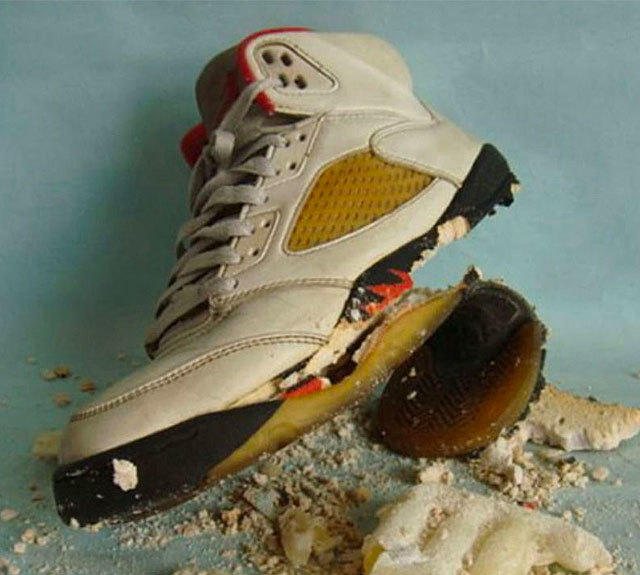
Moisture in the air attacks the polyurethane foam in midsoles — bonds snap, the foam hardens, then crumbles into powdery chunks. That's the dreaded sole crumbling and separation. Worse in humidity.
Oxygen breaks polymer bonds in EVA and PU and forms chromophores — the chemistry behind yellowed soles and cloudy icy outsoles. UV light accelerates it.
Pull the humid air out. Backfill with argon — an inert noble gas used in museums and food packaging. Lock the humidity at the floor with a desiccant. Both reactions slow to a crawl.
Honest framing: we dramatically slow the two reactions that rot sneakers in storage. Nothing stops aging forever — but this is the best you can do short of cryo.
Conservators have preserved irreplaceable artifacts for decades by sealing them and replacing the air with an inert gas — argon or nitrogen — dropping oxygen below ~1%. Established practice, not a theory.
Stores the Declaration of Independence and the Constitution in sealed, argon-filled cases.
Pioneered inert-gas (argon/nitrogen) anoxic storage research for artifacts.
A chemistry professor pointed to exactly this for sneakers: store them in "an airtight vessel filled with argon" — its low reactivity stops PU from degrading.
Shoe Vault brings that same method to your collection: vacuum out the humid air → backfill with inert argon → lock low humidity with a desiccant and a humidity card you can actually see working.
These are real collector pairs — no abuse, no water, just time in a box. This is what air does to PU foam, and exactly what the vault stops.


Slip your pair into the heavy barrier bag. Drop in a desiccant pack and humidity card.
Any household vacuum hose hits the one-way valve. Pull the humid atmosphere out.
A short pulse from the canister backfills with argon. Bag stays soft. Oxygen: gone.
Every collector has the story: you pull a deadstock pair you've been saving, and the sole crumbles in your hands. Years of patience, gone to chemistry no closet could stop.
So we went looking at how the people who preserve actually irreplaceable things — museums, national archives — beat the exact same reactions. The answer was always the same: pull the air, replace it with an inert gas, lock out the moisture.
We sized that down to a shoebox. No lab, no nitrogen tank — a barrier bag, a shot of argon, a desiccant, and a schedule that tells you exactly when to top it off. Museum-grade, for your rotation.
No vaporware. Every dollar is gated to a milestone — we don't spend on tooling until demand is proven, and we don't ship a seal that doesn't hold.
We bench-test the system on real pairs with off-the-shelf barrier bags, a 100% argon can, and desiccant — logging humidity and seal integrity over weeks. Prove the chemistry before we tool anything.
We contract a vetted flexible-packaging + sourcing partner (NDA first) and order branded samples: the resealable barrier bag and one-way valve, a private-label argon canister, and the desiccant + humidity card. Iterate until the seal — and the unboxing — are right.
Shortlist suppliers by RFQ against our spec sheet, evaluate samples head-to-head, audit the factory (or third-party inspect), sign NDAs + a supply agreement, then run a small pilot batch with full quality checks before committing to volume.
First bulk run, packed out and fulfilled through our existing operation — we already source, pack, and ship physical product daily. Backers get tracking. Refill kits go live so protection stays renewable.
Only after the bag tier proves out do we invest in injection-mold tooling for the airtight container, then the argon-flushed glass display case.
RFQ against a written spec, sample bake-off, factory audit, NDA + supply agreement, pilot batch — then volume.
Prototyping and tooling spend is tied to funding milestones, so backer money de-risks the build instead of gambling on it.
An operating team that already fulfills physical product — not a first-time Kickstarter learning logistics on your dime.
This first $15,000 funds the prototype and first production run — we use it to source the real materials, build the kit, and dial it in. Final mix firms up once vendor quotes are locked; we'll publish the real numbers in backer updates.
Charge-at-goal. We only collect if we hit $15K. Full refund if we miss. Early backers get the Founding Backer badge.
1-Bag Kit — preserve a single grail.
Lock down the rotation.
The vault. For people with a problem.
You don't have to buy a kit to be part of this. Chip in as little as $1 to become a Founding Believer — it funds prototyping and proves the shoe community actually wants this. Every dollar you pledge becomes credit toward a kit, your name goes on the Founding Believers wall, and every backer locks in free shipping on their kit.
Charged now via Stripe. A token of support — becomes credit toward a kit. Not an investment or a security.
Early believers become Founding Members — and Founding Members get a real say in what this brand becomes. Not equity, not a stake — a standing voice and a permanent place in the story. (Want actual ownership? That comes later, the legal way — see the FAQ.)
A permanent, numbered spot on the Founders wall.
A standing founder discount on every drop, forever.
Early access to every release and founder-only colorways.
Founders steer colorways, products, and the brand — live, below.
A private community shaping the roadmap with us.
Stackable polycarbonate vault.
Argon-flushed museum cube. Show the grails.
Every real campaign has risk. Here's ours, straight — because trust is the whole game in preservation.
100% argon consumer cans exist and ship today, but locking a reliable private-label filler at our volume is the critical path. Mitigation: we've identified off-the-shelf fallbacks so the kit ships even if branding the can takes longer.
Argon ships ground-only as a Limited Quantity — no air, US-first. We bill shipping at checkout so it never eats the product, and a bag-only / bring-your-own-gas option covers anyone we can't ground-ship.
You get an estimate of added life and a reseal schedule — not a forever guarantee. Preservation depends on your shoe's materials, condition, and keeping up the reseal cadence. We'd rather under-promise and over-deliver.
Sampling and QC can take longer than hoped. We won't ship a seal that doesn't hold — if a tier needs more time, backers hear it early, and nobody is charged until we're a confirmed go.
We didn't start as a sneaker brand. We started as the people who make the boxes. Shoe Vault comes from Nice Supply — a packaging and protective-materials company we run out of Cleveland. We spend our days in barrier films, desiccants, and the science of keeping things safe in storage.
So when a grail I'd been saving crumbled in the box — soles yellowing, foam turning to powder — it was personal and professional. We already had the materials knowledge. We just hadn't pointed it at the thing we love most.
That's Shoe Vault: museum-grade preservation built by people who actually know packaging and run their own fulfillment — not a gadget from a stranger. We're sourcing the real materials and building it in the open, with the community that gets it.
— David Khieu, founder · with Joe, CMO